


Strawberries last longest when they go into the fridge straight from the shop, unwashed, with their green caps on, dry, in a single layer in a lidded container lined with paper towel. Kept like that in the crisper drawer, they can stay good for about a week, depending on how ripe they were when you bought them. The rest of this guide explains why each step matters, what to do when you want to wash them ahead, and how to set up one tidy spot in your fridge so the punnet never gets pushed to the back and forgotten.
TL;DR
- Refrigerate strawberries as soon as you get home, unwashed and with the green tops still on.
- Keep them dry: a lidded container lined with paper towel, berries in one layer, in the crisper drawer.
- Wash only what you will eat, under cool running water, just before eating.
- Check daily and remove any soft or mouldy berry straight away, because mould spreads to its neighbours.
- Surplus berries can be frozen after washing, drying and hulling.
Table of Contents
- Why strawberries spoil so quickly
- The routine: how to store strawberries step by step
- How long will they last?
- The glass jar and vinegar methods
- Give your berries a proper place in the fridge
- When to throw strawberries away
- Making the most of berries that are past their best
- A quick weekly routine
- FAQ
- Sources
Why strawberries spoil so quickly
A strawberry has thin skin, a lot of water inside and a rough surface covered in tiny seeds. That combination makes it one of the most perishable fruits you can buy.
The main enemy is moisture. Colorado State University explains that strawberries are harvested unwashed and that wet fruit encourages bacterial and fungal growth. The fuzzy white or grey mould you see is usually Botrytis cinerea, a common fungus whose spores, according to a University of California publication, are found on nearly all harvested strawberries, especially after a wet harvest. You cannot remove the spores at home. What you can do is keep the berries cold and dry so the spores have little chance to grow.
Warmth is the second enemy. Illinois Extension notes that warm temperatures cause browning because the red pigments in the fruit break down with heat, which also destroys vitamin C. So the clock starts as soon as the berries leave the chiller cabinet, and the quicker they reach your fridge, the better.
The routine: how to store strawberries step by step
1. Get them cold straight away
Refrigerate berries immediately after buying. The University of Arkansas Extension advises refrigerating strawberries immediately after purchase rather than leaving them on the worktop. If your shop takes in a long trip home, put the punnet in the coolest part of your bag.
It also helps to know your fridge is cold enough. The US Food and Drug Administration recommends keeping perishable fruit in a clean fridge at 40°F (about 4°C) or below, checked with a thermometer. In the UK, a fridge thermometer costs very little and takes the guesswork out.
2. Sort the berries and take out the bad ones
Open the punnet and look at every berry. Remove any that are bruised, soft, leaking or mouldy before storing. The University of Maine Cooperative Extension gives the same first step: remove spoiled or crushed fruit before putting the rest away. One bad berry in contact with good ones is the quickest way to lose the lot.
This is also the step where things go wrong most often. A punnet bought on a busy day goes straight into the fridge door, and by the time anyone looks, a mouldy berry has already touched five others.
3. Leave them unwashed, caps on
It feels sensible to rinse berries as soon as they come home. Resist it. Better Homes & Gardens’ Test Kitchen director advises storing berries unwashed and whole because they absorb water, which shortens their shelf life. Healthline adds that keeping the caps on until washing helps prevent juice loss and water absorption. The University of Arkansas Extension also says not to remove caps before storage, since early capping reduces flavour, texture and nutrient quality.
4. Choose a container and line it
The aim is air circulation without moisture. Put a clean, dry sheet of paper towel in the bottom of a lidded container, lay the berries on it, and make sure they are not piled up. The University of Arkansas Extension suggests arranging berries no more than two deep in a shallow container, and Better Homes & Gardens recommends a single layer with a paper towel. Real Simple suggests either airtight glassware or a lidded container with a dry paper towel.
A tidy fit matters here. A container that is too small forces you to stack berries, and the ones at the bottom get crushed and damp. A wide, shallow, clear box is easier to use, and being able to see the berries without opening the lid makes the daily check quicker.
5. Put them in the crisper drawer
The crisper drawer is built to hold humidity, which suits berries better than the open shelves. Real Simple says the crisper best controls humidity, and Healthline gives an ideal range of 32°F to 36°F (0°C to 2°C). Illinois Extension recommends the coldest part of the fridge. Keep fruit away from raw meat, poultry and fish, as the FDA advises.
6. Check daily, wash just before eating
Look through the container each day and remove anything suspect. When you want berries, take out only what you will eat and wash them gently under cool running water. Ohio State University Extension advises washing only what you’ll eat, never soaking them, and never using soap, detergent or bleach. The FDA says the same about soap and commercial produce washes, and adds that drying washed produce with a clean cloth or paper towel further reduces surface bacteria.
How long will they last?
There is no single number, because ripeness at purchase and your fridge temperature both change the answer. Published guidance gives a range:
| Method | Typical time quoted | Source |
|---|---|---|
| Crisper drawer, closed container or partly open bag, optimum conditions | Up to 7 days | University of California |
| Paper-towel-lined container, crisper, unwashed | Up to 5 days | Better Homes & Gardens |
| Shallow container with paper towel | About 3 days | Better Homes & Gardens |
| Loosely covered with plastic wrap | 3 to 4 days | Clemson University |
The spread is wide because the starting point differs. Berries picked ripe and bought the same day behave differently from berries that were already a few days old. Plan to eat the ripest ones first, and treat the shorter figures as the safe plan for berries you cannot assess.
The glass jar and vinegar methods
Two tricks go round social media every summer, and both have some evidence behind them.
Storing in a sealed jar
Better Homes & Gardens reports that a sealed Mason jar can extend life from about three days in a shallow container to up to a week. Real Simple also lists airtight glassware as a good choice for unwashed berries. The principle is the same as everywhere else: dry berries, little handling, cold storage. If you use a jar, make sure the berries go in completely dry, and do not pack them tight.
The vinegar soak
The vinegar method is for people who like to prepare a whole batch at once. Better Homes & Gardens’ Test Kitchen soaked whole berries for 20 minutes in three parts water to one part vinegar, then rinsed them and dried every berry thoroughly. They found that the soak let berries be stored longer before mould and deterioration appeared. The drying is the part people skip, and it is the part that decides whether the method works. Spread the berries on towels or use a salad spinner lined with paper towel, then store them in a single layer in a paper-towel-lined container.
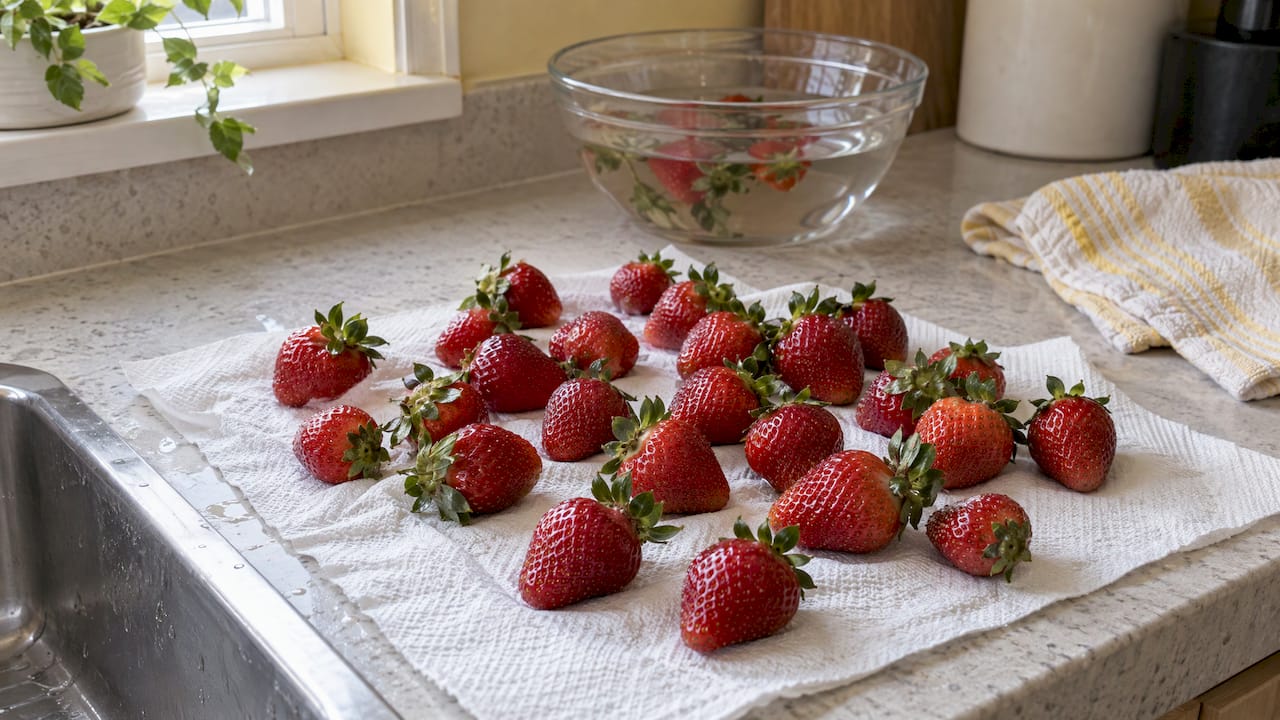
A University of Illinois food scientist describes a similar soak, with roughly half a cup of white vinegar per cup of water or a few teaspoons of baking soda in a large bowl of water, followed by a thorough rinse under running water and a gentle pat dry. His advice is still to wait until just before eating to wash, because wet strawberries are highly susceptible to mould.
So the simple rule holds: if you want the least effort, store them unwashed and dry. If you prefer to wash ahead, follow the soak, dry every berry fully, and keep them in a single layer.
Give your berries a proper place in the fridge
Most spoiled punnets are not caused by the wrong technique. They are caused by berries sitting behind a milk carton, out of sight, until someone notices the smell. A fixed spot solves that, and it is where a little organisation pays off.
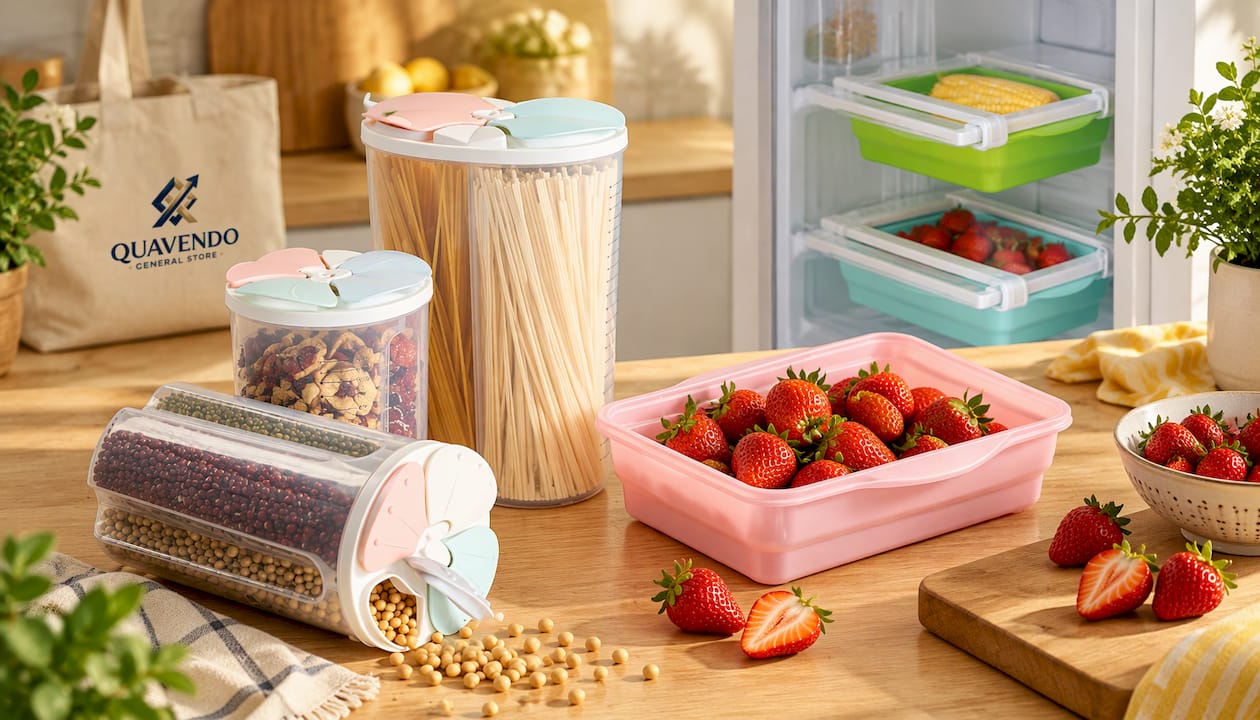
That is the idea behind the fridge organizer with foldable storage boxes from Quavendo. The boxes are transparent, so you can see what is inside, and they give fruit its own section instead of leaving it loose among everything else. Put your lined berry container where you will see it when you open the door, and the daily check takes a few seconds.
For families, a visible berry box has another advantage: children can see the strawberries and ask for them. For couples and busy professionals, it means fewer forgotten punnets and fewer wasted berries at the end of the week.
Quavendo’s transparent plastic food storage containers are another option for the lidded container in step 4. If you would like to see the whole range of kitchen helpers, from food-storage accessories to organisers, browse the Kitchen & Home Solutions collection.
When to throw strawberries away
Mould is not something to cut around casually. In a Mayo Clinic Minute reported by FOX 9, paediatric infectious disease specialist Dr Nipunie Rajapakse says that if only a few berries are mouldy, you should discard those and any berries touching them. If more than about a quarter of the container is mouldy, discard the whole thing.
Use your eyes and nose daily, and be strict about it. Berries that are soft, leaking or smell fermented belong in the food waste bin. Anyone who is pregnant, elderly, very young or has a weakened immune system should be especially careful, and should ask a GP or pharmacist if unsure about food safety.
Making the most of berries that are past their best
If you cannot eat the berries within a few days, freeze them. Ohio State University Extension advises freezing surplus berries after washing, drying and hulling them. Clemson University adds that cut berries in syrup should be used within a day or frozen. Cut or peeled produce, the University of Maine notes, should be refrigerated within two hours and eaten within three to four days.

Frozen strawberries are good for smoothies, sauces and slushies, though they will be too soft for eating whole. A simple habit: on day three, decide which berries you will realistically eat fresh, and freeze the rest while they are still in good condition.
A quick weekly routine
- On shopping day: put the berries in the fridge first, before you unpack the rest.
- Within the hour: sort, remove bad berries, line a container with dry paper towel and arrange the rest in one layer.
- Every day: check, remove any suspect berries, and replace the paper towel if it feels damp.
- Before eating: wash only what you need under cool running water.
- Day three or four: freeze any berries you are unlikely to eat fresh.
FAQ
Should I wash strawberries before putting them in the fridge?
Generally no. Washing adds moisture, and wet berries go mouldy quickly. Colorado State University advises storing them dry and washing with cold water immediately before serving. If you prefer to wash ahead, soak in diluted vinegar, then dry every berry completely.
What is the best way to store strawberries?
Keep them unwashed with the caps on, in a single layer in a lidded container lined with dry paper towel, in the crisper drawer. Remove any damaged berries first and check them daily. Under good conditions they can last up to about a week.
Does putting strawberries in a glass jar work?
It can. Better Homes & Gardens reports that a sealed Mason jar extended storage from about three days to up to a week. The berries must be dry and unwashed, and not crammed in.
How long do strawberries last in the fridge?
Between three days and a week, depending on ripeness and method. University of California guidance gives up to seven days in optimum conditions, while other university guidance is more cautious at two to four days. Use the ripest berries first.
Can I eat strawberries with a bit of mould on them?
No, not the mouldy berries. Discard those and any berries touching them. If more than about a quarter of the container is affected, discard the lot.
Sources
- Strawberries: Safe Methods to Store, Preserve, and Enjoy, University of California
- Storing and Washing Fresh Fruits and Vegetables, University of Maine Cooperative Extension
- Strawberry Basics, Clemson University
- Handling Care, Illinois Extension
- Strawberries, Storage and Preparation, University of Arkansas Extension
- Selecting and Serving Produce Safely, FDA
- Selecting, Storing, and Serving Ohio Strawberries, Ohio State University Extension
- Strawberries, Food Source Information, Colorado State University
- How to Store Strawberries So They Won’t Spoil Quickly, Real Simple
- How to Wash Strawberries: Do’s and Don’ts, Healthline
- How to Wash Strawberries, Better Homes & Gardens
- How to Store Strawberries in the Fridge, Better Homes & Gardens
- How To Wash Strawberries To Remove Dirt and Pesticides, University of Illinois
- Moldy berry in the container: Is it safe? FOX 9


